
Blog.
Introducing the Kritical Claims Engine
Today, we're introducing the Kritical Claims Engine.
Sign up for early access here.
Upload your contract and documents. Describe your claim. Get a fully evidenced narrative, backed by every relevant document in your project. Interim or global, Claims Engine handles both.
Contract Ingestion as the Anchor
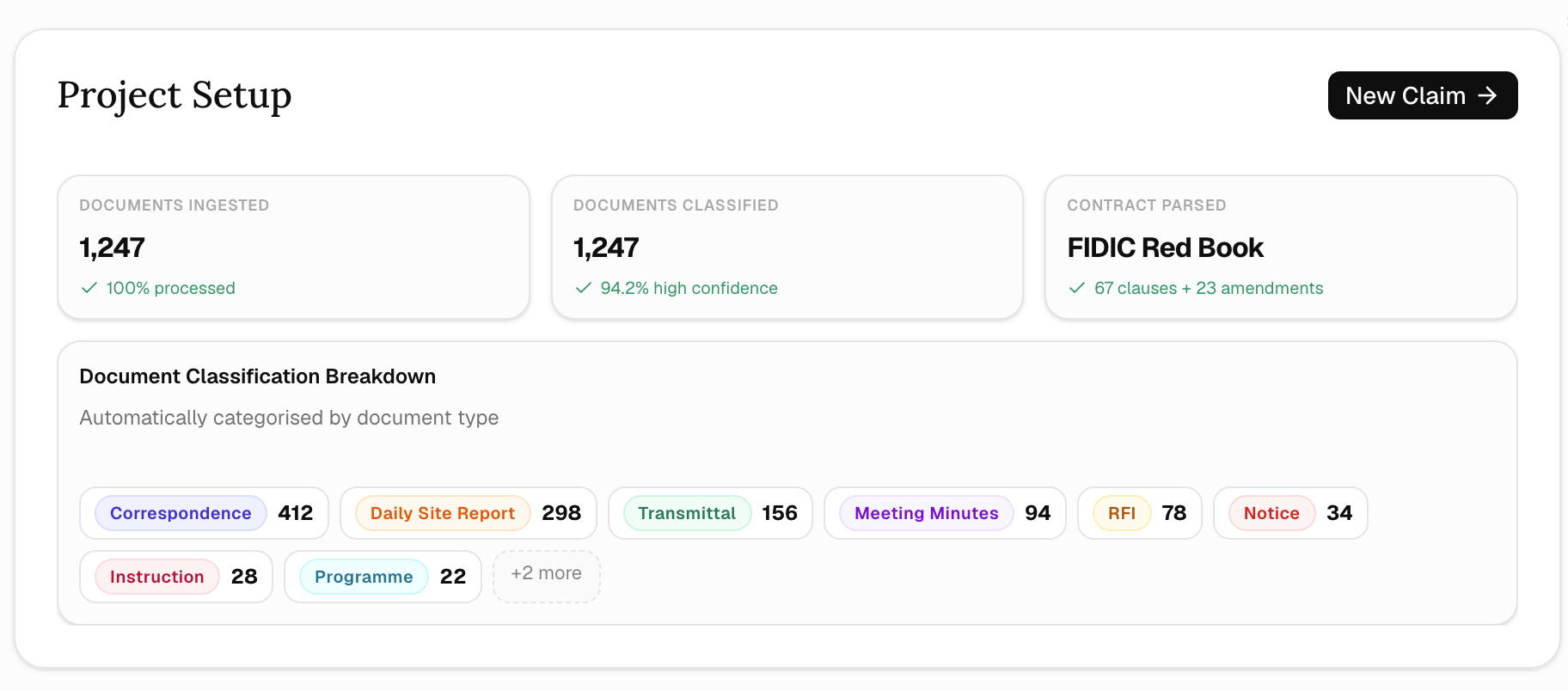
The contract is parsed first so the engine can map governing clauses, definitions, notice requirements, and amended obligations before any claim analysis starts. Particular Conditions and amendment language are preserved as first-class references, not side notes.
Project Record Ingestion and Classification
Correspondence, notices, RFIs, instructions, daily reports, transmittals, programmes, and cost records are ingested and classified into document types with normalized metadata. Each record is tied to date, reference, and sender/recipient context where available.
Clause-Grounded Evidence Retrieval
When a claim is described, the engine maps the narrative to likely entitlement and procedural clauses, then retrieves records against those clauses. Supporting and contradictory documents are both surfaced and ranked by relevance to the contractual basis.
For-and-Against Evidence Review
The review layer lets users keep high-value support, remove weak or noisy records, and deliberately retain adverse documents that must be addressed. Inclusion decisions are made in context, with references visible throughout.
Traceable Claim Package Assembly
Validated clauses, selected evidence, and chronology are assembled into a structured package with references carried through each section. The output is organized for review, handover, and downstream submission workflows.