Blog.
Is contract administration as a service dead?
When we launched contract administration as a service in 1999 at Construction Management Associates, clients came knocking on our door. Demand started with construction contractors in Saudi Arabia, and slowly spread throughout the MENA region. Since then, our contract administration business has grown to support all types of clients across all stages of a project.
We have four theories as to why demand has slowed.
First, there are many more qualified contract administrators in the MENA region than 25 years ago. Back then, the market, particularly in Dubai, was dominated by contract administrators — quantity surveyors or commercial managers, as the British would say — and the homegrown talent was still not around. Naturally, through osmosis and the growth of the regional industry, more people started to study contract administration, and obtain their RICS, CIArb, and AACE certifications. It took approximately one generation for this shift to happen, and today there are some great contract administrators throughout MENA. As a result, the large contractors have been able to build more capable internal teams to run their contract administration functions, and have started to outsource less to companies like ours.
Second, localization and nationalization policies across MENA have gradually reshaped the contract administration talent landscape. Governments across the region, including Saudi Arabia, the UAE, and Qatar, have introduced nationalization programs aimed at increasing local participation in the construction sector. Initially, these policies had limited impact on specialist commercial roles such as contract administration, which continued to be dominated by expatriate professionals. However, as education pathways, professional training, and on-the-job exposure expanded, an increasing number of local professionals moved into these roles. As a result, contractors and developers have been able to align their contract administration functions with localization objectives by developing internal teams staffed with national talent.
Third, the ubiquity of artificial intelligence has begun to reshape how contract administration is delivered. Tasks that were once labor-intensive, such as correspondence tracking, document control, payment certification, variation logging, and early claims identification, are increasingly supported by automation, analytics, and AI-enabled platforms. In leading MENA markets, particularly the GCC, large contractors, developers, and program management offices have invested in these tools to improve efficiency and consistency across portfolios of projects.
Fourth, contractors’ financial claims, accompanying time extension claims, are rarely recognized by employers, particularly in the public sector. And contractors are hesitant to pursue claims in courts in order to preserve the potential for a future working relationship, the fact that such mechanism is installed in the contract by the employer, notwithstanding.
Therefore, claims are primarily used by contractors as bargaining and negotiating tools to set off employer’s claims for liquidated damages for delays. Delays are inevitable on practically all projects for a host of reasons; first and foremost is that the original contract duration was shorter than that required.
A credible claim must be written with the support of authorities e.g. literature, statutes, and court precedents, not opinions. It must be supported by arguments, not rhetoric.
However, the quality of contractors’ claims is rarely interrogated by engineers who have become passionately committed to rejection of claims, whether delay analysis or the admissibility of the quantum claim. This has persuaded contractors that the engagement of a specialist contract administrator is not necessary as the task can be carried out by contractors in-house.
So, is contract administration as a service dead?
We don't think so.
We think the biggest reason for the slowdown is artificial intelligence, but we also think the industry will soon realize that it's not entirely ready to rely on artificial intelligence to be good enough to replace the judgement and experience of a contract administrator who can understand nuance better than a machine.
But there's more to the story.
While demand for contract administration has softened, our claims and dispute resolution business has continued to grow steadily. This divergence raises an important question: if contractors and developers have successfully built in-house contract administration teams, why has the same not occurred at scale in claims and dispute resolution?
Is it because experienced claims and arbitration professionals are harder to find, harder to retain, or harder to develop internally? Or does it reflect a deeper reality—that while routine contract administration can be standardized and partially automated, disputes emerge precisely where complexity, ambiguity, and judgement converge, and where experience cannot be easily replaced by systems or algorithms?
Whatever the reasons for the slowdown in contract administration as a service, one reality is clear: the pace of change is accelerating, and standing still is not an option. To remain competitive, we are deliberately investing in technology as our primary lever for transformation. Through Kritical, we are developing platforms that turn enterprise knowledge into a living asset, capturing experience, judgement, and institutional memory and embedding them directly into everyday workplace decisions and conversations. Our objective is not to replace human expertise, but to amplify it, ensuring that knowledge accumulated over decades continues to inform projects in real time, at scale, and where it matters most.
Definitions
Contract administration is understood to include drafting of contractual correspondence – in meticulous English – on behalf of the contractor or subcontractor, assessment of variations, measurement disputes, preparation of time extension and quantum claims, and claims for escalation.
It is mostly considered that contract administration involves drafting of contractual letters supported by conditions of contract. However, in addition to a thorough understanding of conditions of contract, a contract administrator must be adept in all elements of construction, namely:
Contract drawings.
Technical specifications.
Rules of measurement.
Verification of construction sequence adopted in the project schedule.
Constructibility, involving the difficulty and cost of construction and conflicts between the various trades.
Packaging of subcontracts.
Claims: entitlement evaluation and damages assessment.
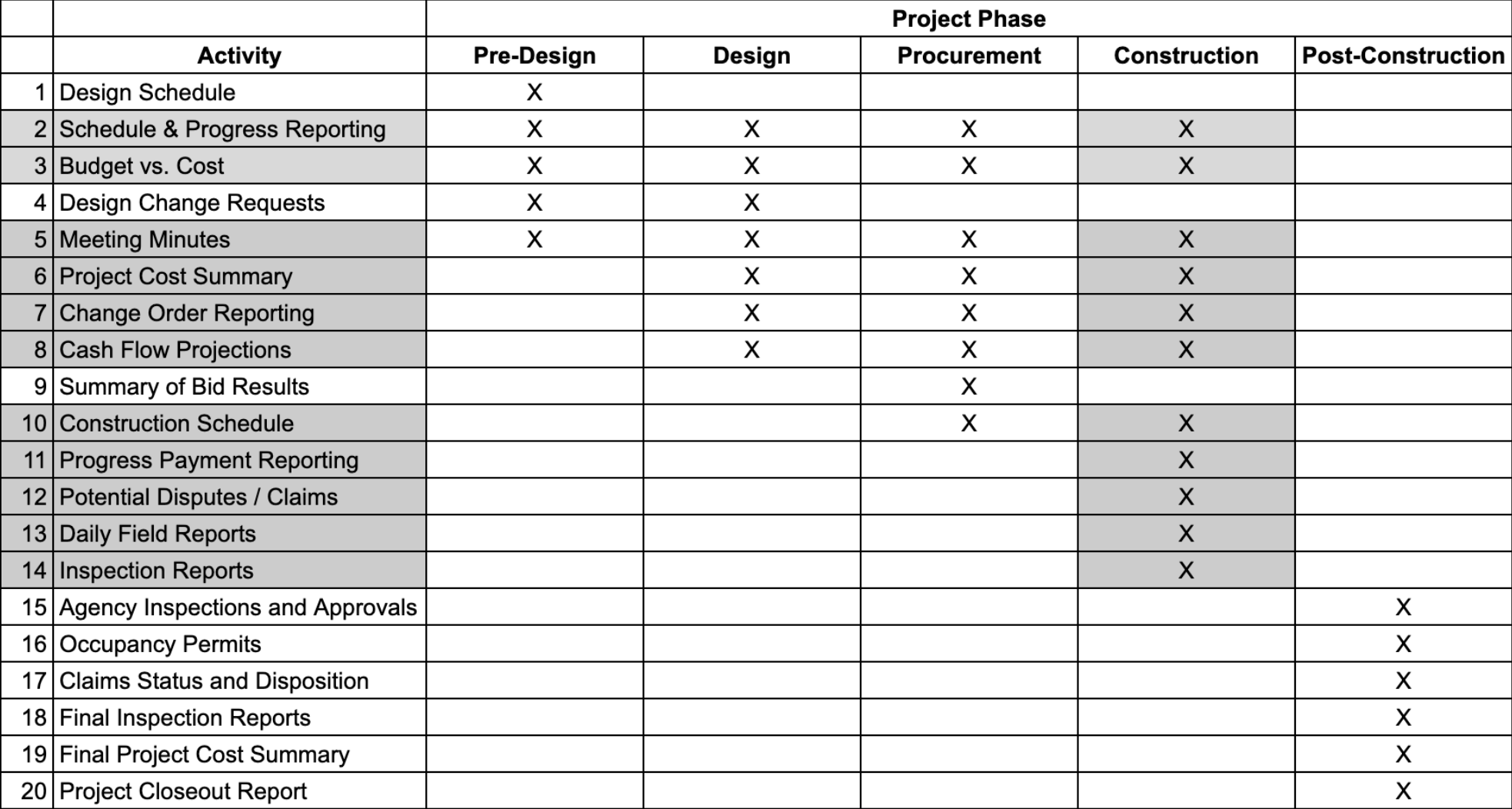
However, the Construction Management Association of America [Standards of Practice] provides the following administrative tasks of the Construction Manager (acting on behalf of the employer) during project execution and the administration and reporting requirements for all phases of the contracts. Activities during construction are shaded.